
Interior Design, Office Design
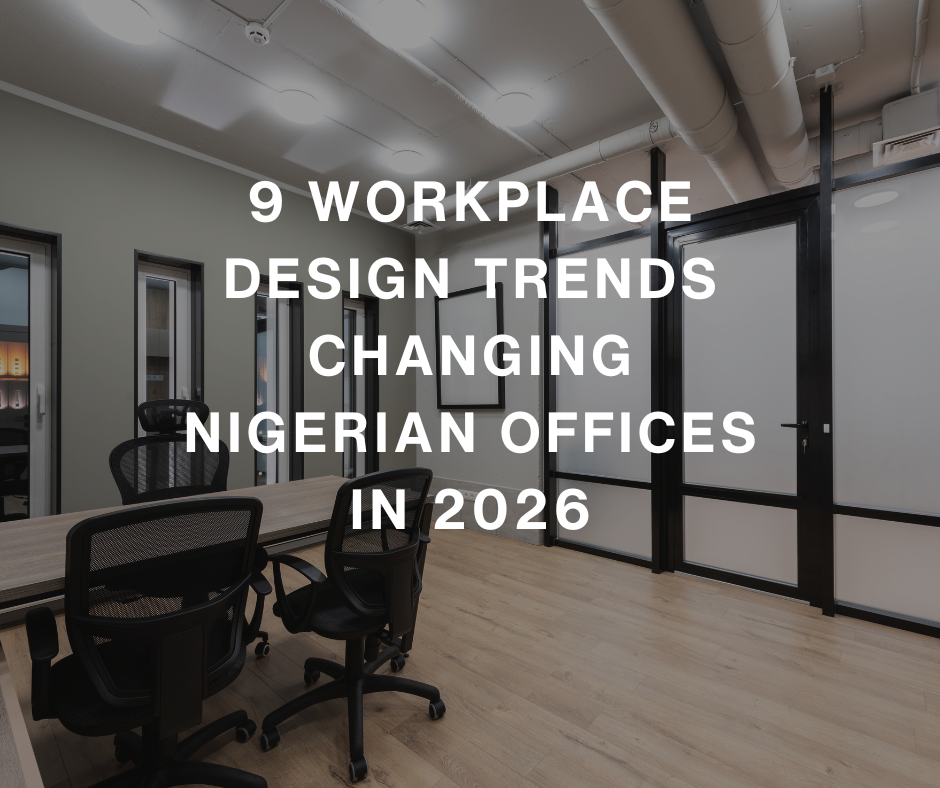
9 Workplace Design Trends Changing Nigerian Offices in 2026
Jan
The role of the office is changing across Nigeria.
Companies are no longer judging workplaces only by location, floor area or the number of desks they can accommodate. They are paying greater attention to employee experience, infrastructure, flexibility, brand expression and the ability of the office to support different types of work.
Recent Lagos office-market reporting shows a growing divide between modern Grade A buildings and older offices. Businesses continue to show interest in properties with reliable power, security, parking and stronger infrastructure, while many ageing offices struggle to retain tenants.
Here are nine trends shaping Nigerian workplaces.
- Flexible Space Planning
Companies are moving away from layouts built around rows of permanently assigned desks. Modern offices increasingly combine:
- Individual workstations
- Meeting rooms
- Focus rooms
- Collaboration spaces
- Informal meeting areas
- Training rooms
- Multipurpose spaces
The objective is to support different activities without increasing the office footprint unnecessarily.
- A Stronger Focus on Employee Experience
Employees now compare the office with the comfort and flexibility available elsewhere. Businesses are considering:
- Comfortable furniture
- Better lighting
- Rest and breakout areas
- Food and refreshment facilities
- Informal collaboration
- Workplace convenience
The office must give people a useful reason to be physically present.
- Zoned Open-Plan Offices
Open-plan offices remain common, but companies are becoming more aware of noise and privacy problems.
Research comparing office configurations found that zoned open-plan and team-based offices produced better employee satisfaction and perceived productivity than completely open layouts.
Successful layouts now separate focused work, collaboration, meetings and social activity.
- Hybrid-Meeting Readiness
A meeting room is no longer complete simply because it has a table and television. Companies need:
- Video-conferencing systems
- Appropriate cameras and microphones
- Acoustic control
- Lighting suitable for video
- Reliable internet
- Accessible power
- Effective cable management
Technology requirements should be coordinated before construction, not added afterwards.
- Brand-Led Workplace Design
Reception areas, meeting rooms, artwork, wall graphics and materials are being used to communicate organisational identity.
This is especially important for businesses that receive clients, recruits, investors and international partners.
- Infrastructure Resilience
Reliable power, cooling, data connectivity and security remain essential workplace priorities in Nigeria.
The continued demand for premium offices with stronger infrastructure shows that occupiers increasingly consider building performance alongside rent and location.
- Better Acoustic Planning
Noise from conversations, calls, meetings and equipment can reduce concentration. Companies are introducing:
- Acoustic ceilings
- Sound-absorbing wall finishes
- Meeting pods
- Enclosed call rooms
- Upholstered surfaces
- Better space zoning
- Adaptable Furniture and Rooms
Businesses want furniture and spaces that can change as teams grow.
Movable tables, modular seating, demountable partitions and multipurpose rooms can reduce the need for frequent renovations.
- More Sustainable Material Decisions
Sustainability is increasingly connected to practical decisions such as:
- Material durability
- Local availability
- Energy-efficient lighting
- Reduced construction waste
- Repairability
- Lifecycle cost
The most sustainable choice is often the solution that remains functional for longer and does not require frequent replacement.
What These Trends Mean for Nigerian Businesses
The modern Nigerian office is becoming:
More flexible, more technology-enabled, more people-focused and more performance-driven.
Companies planning a new office or renovation should begin by studying how their employees actually work. A fashionable design is not enough. The workplace should support concentration, collaboration, technology, culture and future change.
Is your current office still supporting the way your organisation works? Begin with a workplace assessment before deciding what needs to change.